
The digital landscape is undergoing a monumental transformation. For decades, Search Engine Optimization (SEO) was the undisputed king of digital discoverability, focusing heavily on driving clicks by moving up the organic links list on Search Engine Results Pages (SERPs) (Camossi, 2024; Karamuk, 2023).
However, we have entered a major phase change. With the explosive rise of Large Language Models (LLMs) and conversational AI platforms like ChatGPT, Perplexity, Gemini, and Google’s AI Overviews, the primary unit of online competition has shifted from the webpage to the synthesized answer (Figueira, 2025; Karamuk, 2023).
Welcome to the era of Answer Engine Optimization (AEO)—the tactical extension of SEO designed to ensure your content is extracted, cited, and relied upon by AI answer surfaces (Karamuk, 2023; Watanabe, 2026).
What is Answer Engine Optimization (AEO)?
While traditional SEO works to align your website with search algorithms to rank higher in standard web directories, AEO focuses on optimization for synthesis (Figueira, 2025; Karamuk, 2023). Conversational AI platforms rely heavily on Retrieval-Augmented Generation (RAG)—a technical architecture that gathers information from the live web to build real-time, cited answers for users (Karamuk, 2023).
If your data is poorly structured, vague, or locked behind complex layouts, AI crawlers will bypass it, leading to a complete loss of visibility in conversational results (Kultavirta, 2026).
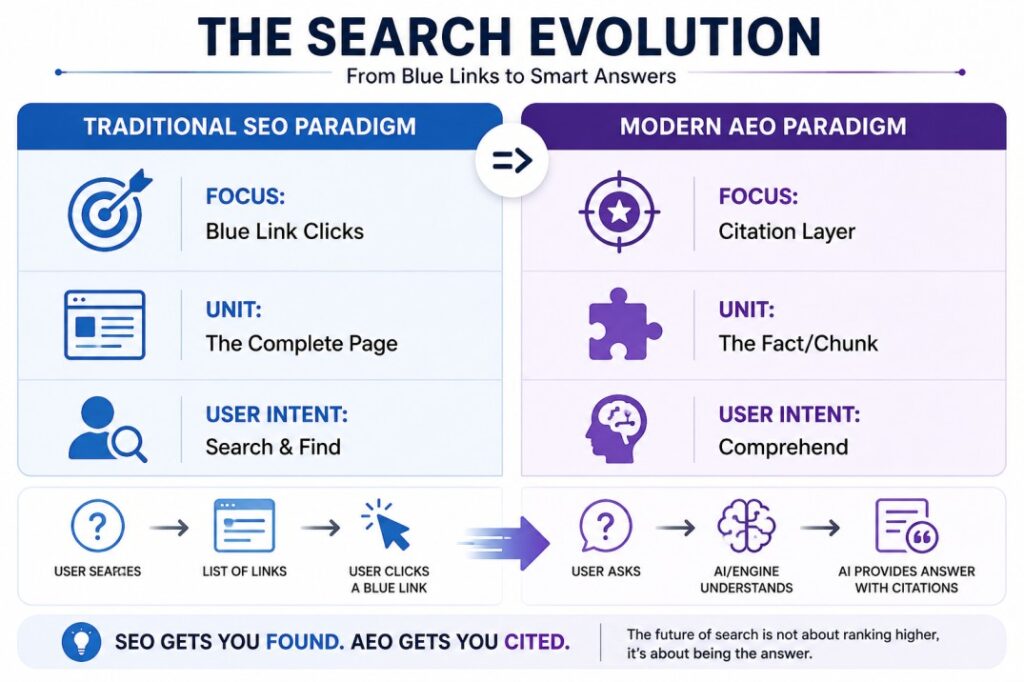
The Strategic Shift: SEO vs. AEO
Understanding how information retrieval has evolved helps clarify why classical keyword stuffing fails completely on modern conversational surfaces.
| Feature / Core Focus | Traditional SEO | Answer Engine Optimization (AEO) |
| Primary Goal | High rankings to maximize click-through rate (CTR) (Sechele, 2024). | Inclusion in the AI answer layer and source citation (Karamuk, 2023). |
| Output Type | A ranked index of external destination links (Karamuk, 2023). | A single, synthesized answer featuring inline citations (Karamuk, 2023). |
| Query Structure | Short fragments (e.g., “best corporate tax software”) (Karamuk, 2023). | Long, highly contextual, goal-oriented strings (Karamuk, 2023). |
| Core Technical Lever | Meta tags, keywords, and domain-level backlinks (Camossi, 2024; Roumeliotis & Tselikas, 2022). | Comprehensive Schema markup and clear semantic structures (Kultavirta, 2026). |
The Direct Answer Dilemma: While direct, AI-synthesized responses offer immense convenience to the end-user, they fundamentally reshape traffic. Users click traditional search links far less frequently when an explicit answer layer satisfies their curiosity directly on the chat surface (Figueira, 2025; Karamuk, 2023).
── INFOGRAPHIC PLACEHOLDER: THE AEO OPTIMIZATION STACK ──
Visual Concept & Design Brief for Graphic Designers
- Placement Reason: This infographic belongs immediately before the tactical breakdown to visualize how backend data directly feeds into public AI responses. It anchors the structural, conceptual, and action-oriented layers of modern optimization before diving into implementation steps.
- Visual Strategy: Create a vertical, multi-tiered pyramid or layer diagram highlighting the AEO–GEO–AgO optimization stack framework (Figueira, 2025).
- Base Layer (AEO): Explicitly labeled “Content Architecture & Schema Markup.” Shows an AI bot crawling clean text blocks and structured tables (Karamuk, 2023; Kultavirta, 2026).
- Middle Layer (GEO – Generative Engine Optimization): Labeled “Citation & Authority Worthiness.” Illustrates an LLM weighing diverse sources to synthesize a response (Figueira, 2025; Karamuk, 2023).
- Top Layer (AgO – Agentic Optimization): Labeled “Delegated Action Execution.” Shows an AI agent interacting with a brand’s API or checkout flow to complete a transaction (Figueira, 2025).
- Palette & Typography: High-contrast, clean corporate tones (e.g., slate gray background with vibrant teal and orange accents to denote data processing flows). Avoid any generic stock photography; stick strictly to clear, icon-driven architecture diagrams.
Implementation Checklist: How to Optimize for AI Engines
To make your content highly readable and appealing to modern AI crawlers, prioritize clear data structures and immediate factual value over fluffy marketing copy.
1.Implement Comprehensive Schema Markup:Technical Foundation.
AI search engines depend heavily on explicit metadata to verify factual parameters (Kultavirta, 2026). Deploy thorough FAQ, Article, Product, and Organization structured data using JSON-LD format. This allows LLMs to pull exact data points without guessing context (Kultavirta, 2026).
2.Restructure Content into Semantic Q&A Chunks:On-Page Optimization.
Structure your web content around explicit question headers (H2/H3 tags) followed by a direct, declarative answer. LLMs ingest data in semantic chunks; keeping the most valuable answer within the first 45–60 words maximizes the chance of it being used as an AI-featured source.
3.Build Uncluttered Data Tables:Formatting for LLMs.
AI engines excel at scraping cleanly organized data. Format pricing models, product feature comparisons, and technical specifications into standard HTML tables rather than buried text paragraphs or complex graphical cards.
4.Establish Strong E-E-A-T and Author Citations:Authority Signals.
Answer engines must protect their accuracy metrics and reduce algorithmic opacity (Kultavirta, 2026). They heavily favor authoritative sources. Back your factual claims with reliable outbound citations, maintain verifiable author profiles, and build natural brand mentions across reputable third-party platforms (Roumeliotis & Tselikas, 2022).
Measuring Success Beyond the Traditional Click
Traditional SEO metrics rely heavily on clicks and impressions tracked via standard search queries (Sechele, 2024). In an AEO environment, tracking becomes more nuanced. True growth must separate your actual causal optimization success from the underlying “platform tailwind” generated by the rapid, explosive growth of LLM usage across the internet (Watanabe, 2026).
Monitor referral traffic coming from AI subdomains (e.g., chatgpt.com or perplexity.ai) via your server logs and first-party analytics (Watanabe, 2026). Keep an eye on your brand’s overall “Share of Voice” inside synthesized summaries to ensure your business remains a core part of the digital conversation as AI search continues to evolve.
References
- Camossi, G. (2024). Optimization strategies for search engines: an analysis based on the data life cycle. RDBCI: Revista Digital de Biblioteconomia e Ciência da Informação, 22, e024011. Cited by: 0
- Figueira, M. G. (2025). From information retrieval to agentic action: A framework for brand visibility in AI-mediated markets. Preprints.org. https://doi.org/10.20944/preprints202502.1034.v1 Cited by: 3
- Karamuk, H. (2023). From SEO to answer engine optimization (AEO): Generative AI and the transformation of search visibility. In Digital Marketing Transformation Dynamics. Kocaeli University Press. Cited by: 0
- Kultavirta, A. (2026). Does website optimization influence AI accuracy? The role of answer engine optimization. (Master’s thesis, Aalto University). Aaltodoc Institutional Repository. Cited by: 0
- Roumeliotis, K. I., & Tselikas, N. D. (2022). An effective SEO techniques and technologies guide-map. Journal of Web Engineering, 21(5), 1540–1589. https://doi.org/10.13052/jwe1540-9589.21510 Cited by: 55
- Sechele, G. (2024). Systematic review on SEO and digital marketing strategies for enhancing retail SMEs’ performance. Preprints.org. https://doi.org/10.20944/preprints202410.1715.v1 Cited by: 13
- Watanabe, K. (2026). Disentangling answer engine optimization from platform growth: A log-based natural experiment on ChatGPT referral traffic. arXiv preprint, arXiv:2606.04362. Cited by: 0
If you are intersted in AI Digital Marketing then explore a trending live training course at govindrana.com