
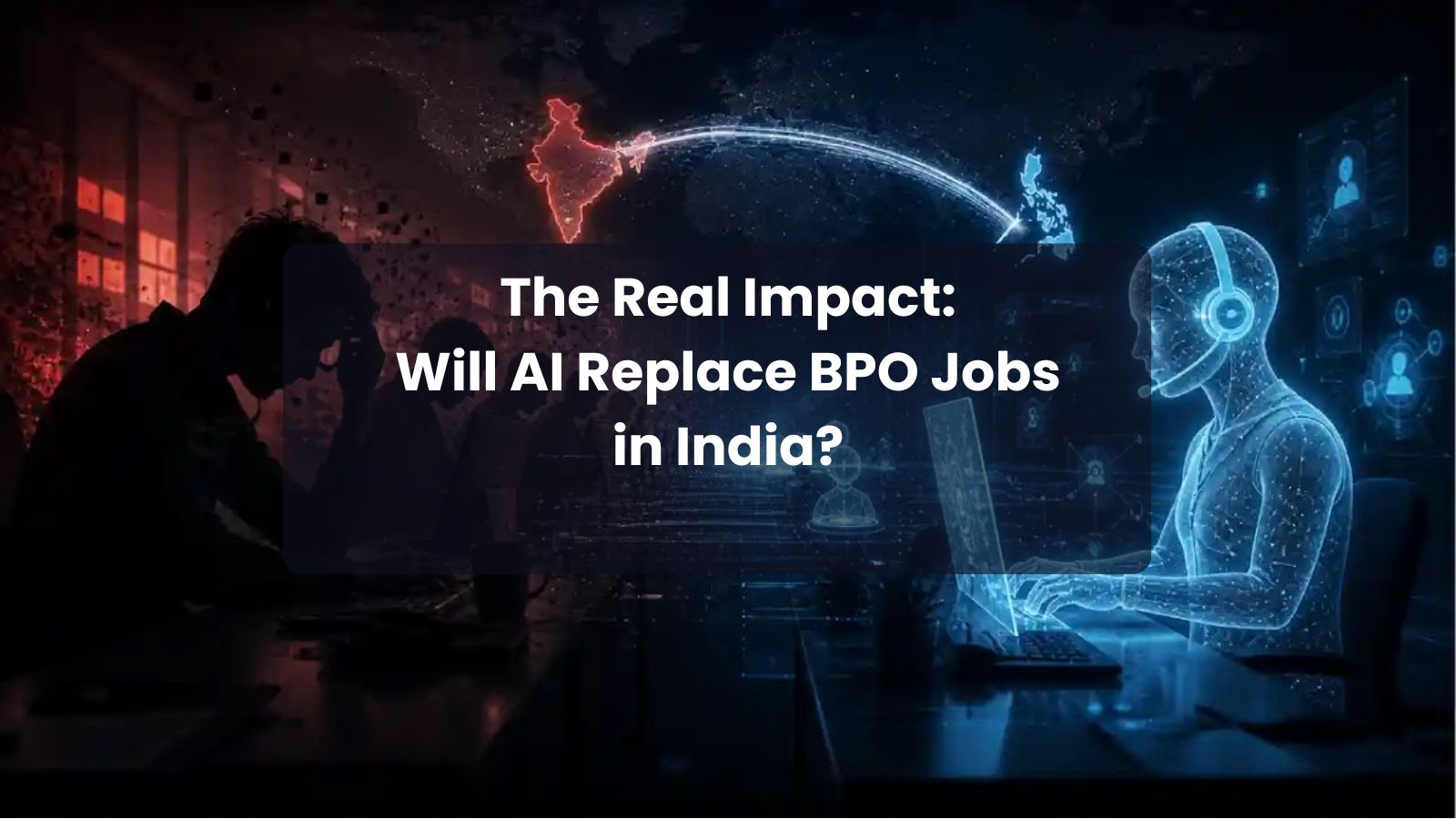
The Indian Business Process Outsourcing (BPO) industry has long been a pillar of the nation’s economic engine, employing over 5 million professionals and driving billions in export revenue (AB7 Solutions, 2026). However, the explosive rise of conversational AI, generative voice bots, and agentic workflows has sparked intense anxiety across the sector.
High-profile tech futurists are issuing stark predictions, claiming that traditional outsourcing models could completely dissolve over the next five years (LiveMint, 2026). But a closer, data-driven look reveals that the market is undergoing a structural evolution rather than a simple workforce elimination (ResearchGate, 2026).
The Shift from Labor Arbitrage to Cognitive Augmentation
For decades, the core value proposition of Indian BPOs relied on labor arbitrage—providing low-cost human capital to handle high-volume, repetitive tasks (ModernZen, 2026). AI is directly dismantling this model by automating routine operational tasks.
The disruption functions across two parallel tracks:
- Substitution: Artificial intelligence excels at executing rule-based, repetitive actions. Legacy tasks like simple data entry, manual form processing, and basic tier-1 ticket routing are rapidly being replaced by intelligent automated systems operating with nearly 100% accuracy (AB7 Solutions, 2026; SquadStack, 2026).
- Augmentation: Complex, customer-facing roles are not being eliminated; instead, they are being supercharged. Real-time AI co-pilots assist human agents with live sentiment analysis, immediate knowledge retrieval, and predictive compliance monitoring, driving a 40% increase in productivity (ModernZen, 2026; SquadStack, 2026).
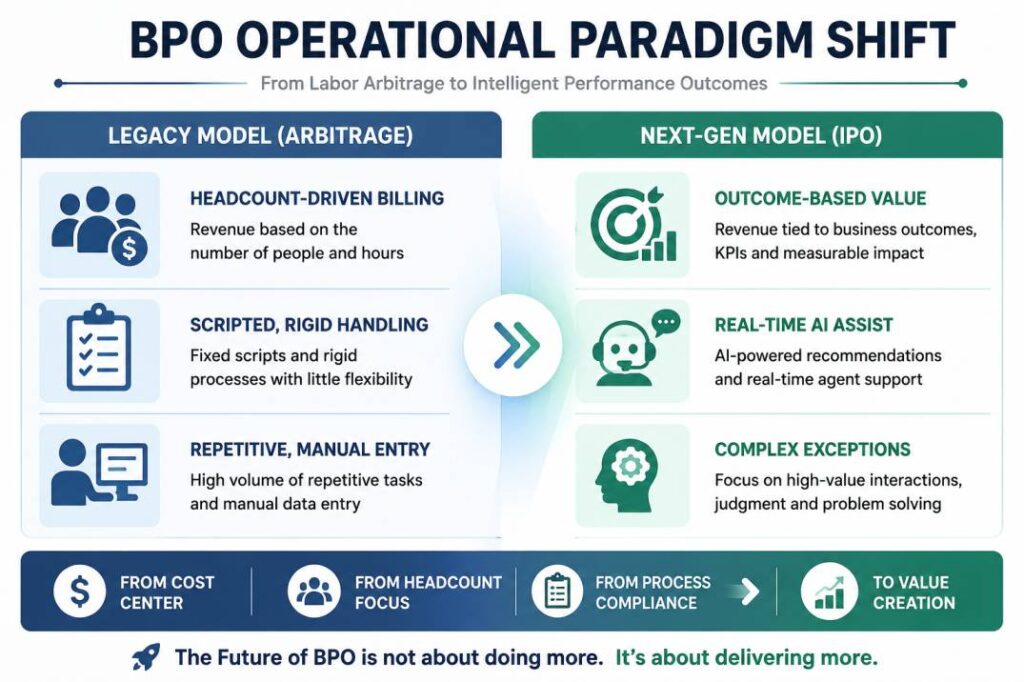
Structural Comparison: The BPO Evolution
The BPO professional’s role is shifting dramatically from basic execution to strategic system management.
| Operational Focus | Traditional BPO Operations | Next-Gen AI-Native BPO |
| Core Value Driver | Scale of human headcount and hourly billing. | Outcome-based solutions and specialized AI workflows (ModernZen, 2026). |
| Handling of Low-Value Tasks | Managed by entry-level agents reading scripts. | Absorbed completely by 24/7 autonomous voice & chat agents (SquadStack, 2026). |
| Human Agent Imperative | Execution speed and error reduction. | Complex exception handling, empathy, and AI model training (AB7 Solutions, 2026). |
| Contractual Architecture | Input-based billing (Pay-per-hour/seat). | Value-driven alignment based on direct business metrics (ModernZen, 2026). |
The Outcome-Based Transition: General, horizontal BPO service providers are facing severe margin compression. The market is shifting value toward specialized providers who control niche industry workflows—like healthcare revenue cycles or financial compliance—and structure their contracts around client success metrics rather than raw labor hours (ModernZen, 2026).
── INFOGRAPHIC PLACEHOLDER: THE EVOLUTION OF THE INDIAN BPO WORKER ──
Visual Concept & Design Brief for Graphic Designers
- Placement Reason: This infographic belongs immediately before the tactical breakdown of new job categories. Placing it here visually reinforces the transition from old operational roles to new AI-driven careers, making the abstract concept of “workforce evolution” immediately clear and actionable for the reader.
- Visual Strategy: Create a clean, side-by-side comparative timeline or transformation map.
- Left Column (The 2016 Agent): Depict an icon of a worker wearing a traditional headset, tied to words like “Script-Reading Agent,” “Manual Invoice Processor,” and “Data Entry Operator” (AB7 Solutions, 2026).
- Center Transition (The Tech Shift): Illustrate a processing gear or data loop labeled “RAG & Voice AI Automation Layer” (SquadStack, 2026).
- Right Column (The 2026 Specialist): Depict an empowered professional looking at an analytics dashboard, tied to emerging titles like “Customer Experience Specialist,” “Rider of RPA Workflows,” and “AI Quality Assurance Analyst” (AB7 Solutions, 2026).
- Palette & Typography: Use a high-contrast corporate palette, such as deep navy blue backgrounds with crisp teal and amber elements to distinguish legacy states from modern technical career paths. Avoid cluttered stock photography; prioritize clean vector icons and scannable blocks.
The Emergence of New AI-Native Job Categories
As automated voice agents and algorithmic tools absorb lower-tier tasks, they simultaneously generate a massive structural demand for highly skilled human operators to guide, manage, and audit these systems (AB7 Solutions, 2026; SquadStack, 2026).
1.Transition to Intelligent Process Outsourcing (IPO):System Baseline Setup.
BPOs must first integrate AI and automation directly into their core infrastructure as a foundation rather than an add-on. This allows the system to process high-volume, rule-based operations with flawless baseline data consistency (ModernZen, 2026).
2.Establish AI Quality Assurance and Prompt Operations:Deploying the Human Audit Layer.
Once the automated layer is live, human operators must pivot to configuring, auditing, and refining the language models. This includes building clean datasets for training, evaluating edge-case conversational failures, and optimization via prompt engineering (AB7 Solutions, 2026).
3.Elevate Agents to Relationship and Exception Managers:Managing Complex Exceptions.
When conversational AI encounters complex customer frustrations or multi-tiered regulatory problems, the system seamlessly routes the interaction to a human expert. Human agents act as strategic decision-makers, leveraging empathy and advanced problem-solving skills to manage exceptions (ResearchGate, 2026).
4.Pivot Toward Domain-Specific Knowledge Process Outsourcing:Hyper-Specialization.
The final evolutionary tier requires deep vertical specialization. Talent must build expertise in highly regulated industries—such as legal research, financial fraud forensics, or specialized healthcare analytics—where contextual human evaluation remains entirely irreplaceable (ModernZen, 2026).
Conclusion: Adapting to the New Reality
AI is undeniably disrupting the traditional, headcount-driven outsourcing industry in India, but it is not a zero-sum game of total job elimination. The future belongs to a hybrid model where autonomous tools absorb routine operational burdens, allowing the Indian workforce to move up the value chain into technical oversight, complex problem solving, and product-focused AI services (AB7 Solutions, 2026; Unity-Connect, 2026).
References
- AB7 Solutions. (2026). Is AI Killing BPO Jobs in India? The Truth Behind the Headlines (And Why Smart BPOs Are Thriving). AB7 Insights Blog.
- LiveMint. (2026, February 16). AI Summit 2026: Vinod Khosla warns of job market shake-up, says IT and BPO roles will vanish in 5 years. Mint.
- ModernZen. (2026). The BPO Industry at an Inflection Point: AI, Disruption, and Strategic Rebalancing. ModernZen Business Review.
- ResearchGate. (2026). What is the latest research about impact of AI in BPO industry and shared service center industry? ResearchGate Contextual Forum.
- SquadStack. (2026). How AI is Transforming the BPO Industry in 2026. SquadStack Voice Automation Reports.
- Unity-Connect. (2026). Tech Investor Warns AI Could Disrupt India’s IT and BPO Model Within Five Years. Unity Communications Industry News.
AI Will Replace BPO? Vinod Khosla on India’s Biggest Economic Shift
This detailed interview explores the macroeconomic shifts facing India’s outsourcing model, highlighting the critical choice between traditional labor-driven services and a future focused on exporting AI products.
If you are intersted in AI Digital Marketing then explore a trending live training course at govindrana.com