
The debate surrounding automation is no longer about a distant corporate future. It is a present-day reality rewriting the rules of employment. As a global technology hub, India stands at a critical crossroads. A landmark joint study by Indeed and Nasscom reveals that 86% of Indian employers see AI actively redefining job roles, with 40% planning a total overhaul of their workforce strategies to prioritize AI-ready capabilities (CIO&Leader, 2026).
The traditional security net of having a formal academic degree is giving way to a more dynamic metric: demonstrable skill execution (CIO&Leader, 2026). Surviving and leading in this new ecosystem requires professionals to rapidly bridge the gap between human intuition and machine efficiency.
The Great Skills Rebalance
The evolution of technology inside Indian enterprises is driving an intense shift in what makes an individual employable. The market is moving away from routine, script-based tasks and toward a model anchored in human-machine collaboration (Wheebox, 2026). Over 90% of working professionals in India now leverage Generative AI tools in their daily tasks, illustrating that the technology is an active workplace partner rather than a niche corporate tool (Wheebox, 2026).
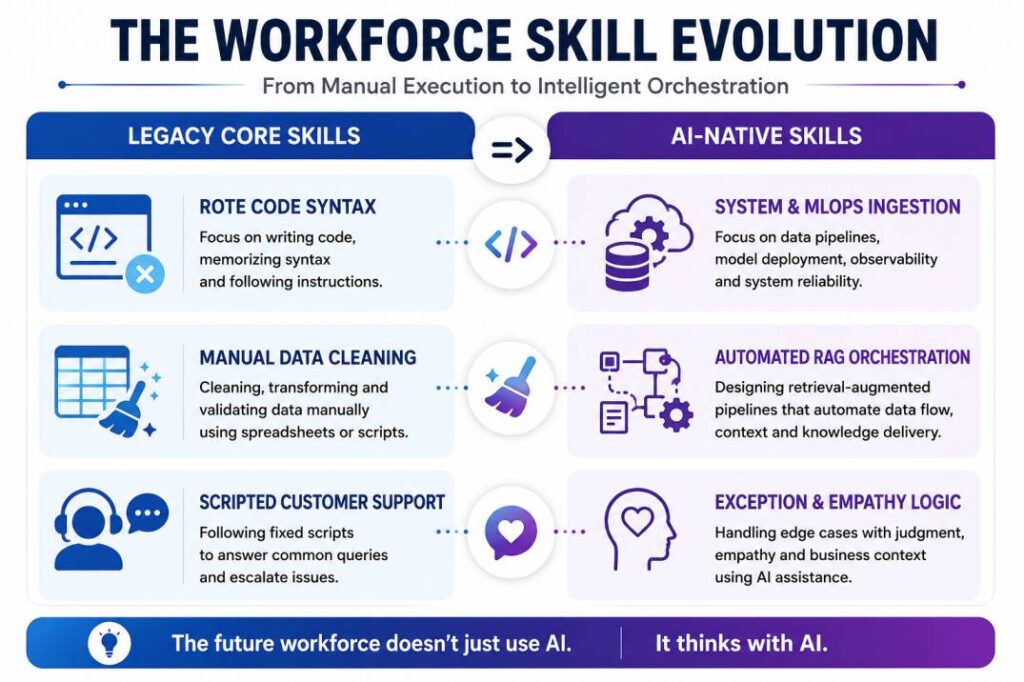
Structural Comparison: Shifting Employment Dynamics
The transition from a standard digital workforce to an AI-augmented talent base requires an entirely different set of technical and cognitive filters.
| Professional Domain | Traditional Skills Base | AI-Revolution Survival Skills |
| Technical Core | Basic programming syntax, manual QA testing, and localized script execution (CIO&Leader, 2026). | Gen AI/LLM integration, MLOps deployment, and clean data engineering pipelines (CIO&Leader, 2026). |
| Cognitive Framework | Process compliance, structured data entry, and adherence to static corporate playbooks. | Prompt engineering, advanced semantic data analysis, and predictive model auditing (Cambridge Infotech, 2026). |
| Human Center | Basic transactional communication and standard account management. | High-empathy exception handling, cross-functional leadership, and ethical AI governance (Nasscom, 2026). |
| Hiring Metric | Major emphasis placed on formal institutional degrees and years of static domain experience. | Verified capability certifications, open-source portfolio builds, and demonstrable AI workflows (CIO&Leader, 2026). |
The Certification Premium: The corporate landscape has reached a clear tipping point. Roughly 40% of modern tech employers explicitly favor validated hands-on certifications and demonstrable tool applications over traditional university degrees when assessing entry-level proficiency (CIO&Leader, 2026).
── INFOGRAPHIC PLACEHOLDER: THE TRIAD OF AI SURVIVAL SKILLS ──
Visual Concept & Design Brief for Graphic Designers
- Placement Reason: This infographic belongs directly before the implementation checklist to visualize the balanced mix of technical, cognitive, and human-centric skills needed to remain indispensable. It gives the reader a clear, structured framework before they dive into specific upskilling steps.
- Visual Strategy: Create a balanced, three-part Venn diagram or structural triangle demonstrating the interconnected layers of the future-proof professional.
- Left Node (The Technical Layer): Labeled “System Mechanics.” Uses crisp icons to display data pipeline engineering, python architecture, and MLOps deployment mechanics (CIO&Leader, 2026).
- Right Node (The Cognitive Layer): Labeled “Orchestration & Prompting.” Illustrates context window structuring, generative fine-tuning, and direct semantic analysis workflows (Cambridge Infotech, 2026).
- Top Node (The Human Moat): Labeled “Irreplaceable Human Capitals.” Features clean graphics representing complex exception handling, cross-cultural leadership, and responsible AI ethical governance (Nasscom, 2026).
- Palette & Typography: High-contrast corporate palette utilizing minimalist charcoal backgrounds accented by electric teal, soft amber, and stark white labeling to ensure maximum visual scannability. Avoid generic stock images of glowing robotic brains; focus purely on clear, flat vector icon representations.
Your Upskilling Roadmap: 4 Core Pillars to Master
To establish an enduring career moat against automated displacement, professionals must systematically build competence across both machine mechanics and strategic oversight.
1.Master Prompt Engineering and Context Architecture:The New Communication Layer.
The interface of work has shifted to natural language. Professionals must learn to build robust system instructions, avoid algorithmic hallucinations, and anchor LLM outputs within strict operational guidelines to maximize output accuracy (Cambridge Infotech, 2026).
2.Develop Proficiency in Data Analytics and MLOps:The Operational Backbone.
AI models are entirely dependent on high-quality, structured information. Developing hands-on experience with modern data cleaning, ETL (Extract, Transform, Load) pipelines, and deployment frameworks like cloud infrastructure integration is a massive competitive advantage (CIO&Leader, 2026).
3.Specialize in Complex Exception and Relationship Handling:The Strategic Filter.
Automated workflows excel at answering standard, high-volume inquiries but fail when facing unique exceptions. Career security lies in taking over when the machine reaches its limit—requiring advanced analytical thinking, emotional intelligence, and non-linear troubleshooting.
4.Acquire Expertise in Responsible AI and Ethical Governance:The Compliance Moat.
As enterprises scale their automated systems, managing compliance risks becomes a top priority. Professionals who understand the practical execution of data privacy laws, algorithmic transparency, and responsible framework auditing are highly sought after by corporate leadership (Nasscom, 2026).
Conclusion: Empathy and Agility as a Moat
The ongoing industrial shift across India is not a narrative of absolute human replacement, but one of radical job redefinition (CIO&Leader, 2026). The professionals who thrive will be those who view automated platforms as a powerful layer of leverage—combining technical literacy with deep human empathy and strategic agility to drive meaningful business outcomes.
References
- Cambridge Infotech. (2026). Top AI Skills in 2026: Complete Guide for Indian Students. Cambridge Technical Insights.
- CIO&Leader. (2026, May 22). Top Skills Employers Prioritise in 2026 as AI Redefines Jobs Across Industries: Indeed–Nasscom Report. CIOandLeader Bureau.
- Nasscom. (2026). The State of Responsible AI in India 2025 survey report. Nasscom AI Research Publications.
- Wheebox. (2026). India Skills Report 2026: The Future of Work – Gig Workforce, Freelancing, AI-Supplemented Workforce, Remote Work & Entrepreneurship. Wheebox Global Employability Assessment.
India’s Next AI Billionaires? Students Reveal the Future of AI
This video features discussions from ground zero at the India AI Impact Summit, offering real-world perspectives from student innovators, founders, and policy leaders on how the country is democratizing compute power and building future-ready talent infrastructure.